Powertrain Component
Base class for all powertrain components including EngineComponent, ClutchComponent, TransmissionComponent, DifferentialComponent, and WheelComponent.
Overview
PowertrainComponent implements a physically accurate solver based on torque and angular velocity calculations. Components are connected in a chain where each can output to one or more others, with EngineComponent as the power source and WheelComponent as the power sink.
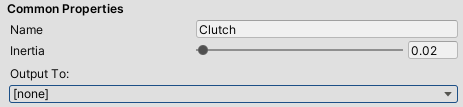
Common Properties
Name
Unique identifier for the component. Changing this resets all output connections for components that reference it.
Inertia
Angular inertia in kg·m². Each component's inertia contributes to overall system inertia, affecting how quickly the powertrain spins up or down.
- Low (0.001-0.01): Responsive but easy to stall, may be unstable
- Medium (0.02-0.2): Balanced, suitable for most vehicles (default: 0.02)
- High (0.5+): Sluggish, difficult to stall, suitable for heavy machinery
Must be greater than 0.0001 to prevent numerical instabilities.
Output
Specifies which PowertrainComponent receives torque from this component. Some components (like DifferentialComponent) have multiple outputs.
Position
Local space position relative to vehicle transform. Used for gizmo visualization and sound positioning.
Runtime Values
During play mode, the following values are computed:
- InputRPM / OutputRPM: Shaft speeds in revolutions per minute
- inputTorque / outputTorque: Torque values in N·m
- inputAngularVelocity / outputAngularVelocity: Angular velocities in rad/s
- inputInertia / outputInertia: Accumulated inertia values in kg·m²
Damage System
The Damage property (0-1) affects component performance:
- 0.0: Full efficiency
- 0.0-0.3: Minor degradation
- 0.3-0.7: Significant performance loss
- 0.7-1.0: Severe damage, potential failure
Solver Methods
The powertrain solver operates in multiple passes:
- QueryAngularVelocity: Propagates angular velocity from wheels toward engine
- QueryInertia: Accumulates total system inertia
- ForwardStep: Propagates torque from engine toward wheels
- QueryReturnTorque: Collects counter-torque after wheel physics step
Notes
- WheelComponent inertia is determined by WheelController mass and radius settings
- Components use name hashing for serialization and efficient lookup
- Higher total inertia results in slower acceleration but better stall resistance