Differential Component
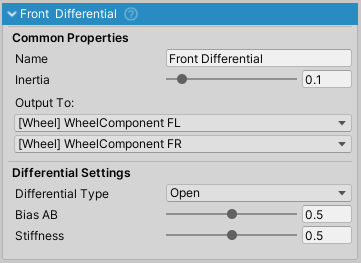
DifferentialComponent is a type of PowertrainComponent that splits
input torque between two or more outputs.
There can be multiple DifferentialComponents present on one vehicle
and one differential can output to other differentials which is useful
for 4WD setup with center differential.
Note: Unused differentials should be removed. E.g. a front differential that none of the other powertrain components (transmission, other differentials, etc.) are outputting to should be removed, as only powertrain components that have a path to Engine are updated.
Differential Types
Open
Torque in open differential is equally split between the left output and right output. Wheels can turn at different speeds, which can result in one-wheel spin with loss of traction. Typical for economy cars.
Locked
Locked differential acts as a solid axle, forcing both outputs to rotate at the same speed. Provides maximum traction but poor cornering behavior. Typical for off-road vehicles.
| Setting | Description |
|---|---|
lockedStiffness |
How rigid the lock is (N·m per rad/s). Typical: 75000 for 50Hz physics, 150000+ for 120Hz+ |
lockedDamping |
Prevents oscillation. Typical: 0-500. Use if seeing jitter |
lockedMaxTorqueMultiplier |
Limits maximum corrective torque to prevent physics instability |
Limited Slip (LSD)
Clutch-type limited-slip differential with realistic ramp angle simulation. Provides progressive locking based on input torque and speed difference.
Ramp Angles control locking behavior - lower angles provide more aggressive locking:
| Setting | Description |
|---|---|
preloadTorque |
Base locking force always present, even unloaded (Nm). Typical: 50-150 Nm for street, 100-200 Nm for race |
slipTorqueCoefficient |
Load-dependent locking strength. Multiplies input torque to determine locking force. Typical: 0.3-0.5 for street, 0.5-0.8 for race, 0.8-1.2 for aggressive setups |
powerRampAngle |
Locking aggression under acceleration (degrees). Lower angle = more locking. 45° = baseline, 30° = aggressive drift, 60° = mild street |
coastRampAngle |
Locking under engine braking (degrees). 80-90° = 1-way (drift), equal to power = 2-way (race), higher than power = 1.5-way (street) |
powerCoastBlendZone |
Torque range for smooth power/coast transition (Nm). Prevents sudden handling changes |
lsdResponseRate |
How quickly LSD locks/unlocks. 0.3 = smooth for 50Hz, 0.5-0.8 for higher physics rates |
LSD Presets:
- Street (1.5-way): Moderate locking on power, less on coast. Good all-around balance.
- Race (2-way): Equal locking in both directions. Predictable corner exit.
- Drift (1-way): Strong lock on power, almost none on coast. Easy rotation initiation.
- Off-Road: Strong 2-way locking for maximum traction.
Torsen (Torque-Sensing)
Gear-type differential that biases torque to the wheel with more traction. Very smooth and progressive operation. Typical for AWD center differentials (Audi Quattro, Subaru STI).
| Setting | Description |
|---|---|
torqueBiasRatio |
Maximum torque ratio between outputs. Typical: 2.5-4.0. TBR of 3.0 = 75%/25% max split |
Common Settings
These settings apply to all differential types:
| Setting | Description |
|---|---|
biasAB |
Static torque bias between outputs A (left) and B (right). 0.5 = equal split, 0 = all to A, 1 = all to B |
gearRatio |
Gear ratio for wheel size compensation. Default 1.0. Scales angular velocity and torque. Example: If rear wheels are 1.25x larger than front, set rear diff ratio to 1.25 |
Removed in 14.2:
powerStiffness/coastStiffness- old LSD parameters; use the ramp angles above instead.slipTorque- on existing prefabs its value was baked intopreloadTorque, so the diff lock is unchanged. Load-dependent locking is now set withslipTorqueCoefficient.
Differential Steering
For tracked vehicles such as excavators, enable differentialSteering to control vehicle direction
by varying torque distribution between left and right outputs based on steering input.
| Setting | Description |
|---|---|
differentialSteering |
Enable torque-based steering for tracked vehicles |
steeringRange |
Maximum steering range (0-1). At 0.8, full steering gives 80% torque difference. Prevents track reversal at full lock |
Telemetry & Debugging
Runtime telemetry properties for tuning and debugging (read-only):
| Property | Description |
|---|---|
lockingPercentage |
Current locking state (0-1). 0 = fully open, 1 = fully locked |
actualTorqueSplitAB |
Actual torque split after differential action. -1 = all to A, 0 = balanced, +1 = all to B |
speedDifference |
Speed difference between outputs in rad/s (OutputA - OutputB) |
correctiveTorque |
Corrective torque being applied by differential mechanism (Nm) |
torqueA / torqueB |
Actual torque sent to each output after differential correction (Nm) |
These values are visible in the inspector when the vehicle is playing and help diagnose differential behavior.
Configurations: 4WD / 2WD / etc.
To achieve a specific drivetrain configuration, different differential layouts can be used. For example:
- RWD: Set the Transmission output to a Differential whose outputs are rear wheels.
- FWD: Same as RWD, but with the Transmission outputting to a Differential whose outputs are front wheels. Remove any unused differentials.
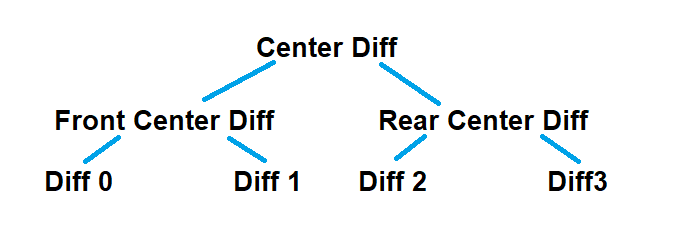
- AWD/4WD: Can be achieved through three differentials; front, rear and center. The center differential should output to front and rear differentials, which then output to front and rear wheels, respectively.
- Adjustable: A configuration of differentials as in the AWD setup can be used, but with the center differential set to Open type. Adjusting the BiasAB slider on the center differential to 0 will make the car FWD and adjusting it to 1 will make it RWD, assuming the first output of the center differential is the front differential.
- 8x8 and similar: A tree of differentials can be built, which allows for setups such as 6x6, 8x8, etc. Example: