Jet Propulsor
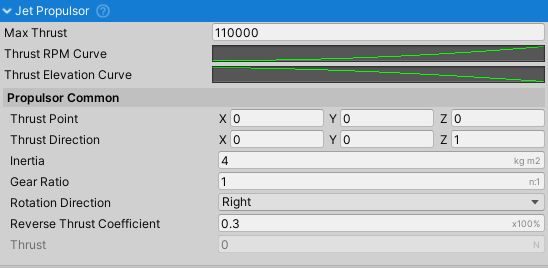
Direct thrust turbofan/turbojet propulsor without propeller. Generates thrust based on engine RPM and atmospheric altitude/density.
Paired with TurbineEngine to convert turbine power into jet thrust.
Configuration
Basic Setup
maxThrust- Maximum thrust output at sea level in Newtons (e.g., 60000 N)thrustRPMCurve- Thrust variation with engine RPM. X-axis: 0 (idle) to 1 (max RPM), Y-axis: thrust multiplierthrustElevationCurve- Thrust variation with altitude and air density. X-axis: 0 (sea level) to 1 (near vacuum), Y-axis: thrust multiplier
Common Properties
Inherited from PropulsorBase:
Thrust Point- Where thrust applies to the aircraft (local coordinates)Thrust Direction- Direction of thrust application (local coordinates)Gear Ratio- Multiplier between engine RPM and propulsor RPMInertia- Spin-up/down speed (higher = slower)Reverse Thrust Coefficient- Fraction of thrust when engine reversed
Operation
Thrust is calculated from three factors:
- RPM Factor - Evaluated from
thrustRPMCurveat normalized RPM (current RPM / max RPM) - Altitude Factor - Evaluated from
thrustElevationCurveat normalized air density (1 - density ratio) - Maximum Thrust - Scaled by
maxThrust(Newtons)
Thrust = thrustRPMCurve(RPM%) × thrustElevationCurve(Altitude%) × maxThrust
Typical efficiency is lower at low RPM and high altitude. Use thrustRPMCurve and thrustElevationCurve to model real jet performance characteristics.
For visual effects (exhaust plume, glow), pair with JetPropulsionEffects component.